


What Does Organic Olive Oil Mean? A Guide to Certification and Labels
Pick up a bottle of olive oil today and you may notice a small green leaf made from white stars somewhere on the label. It is the European…
09 MARCH 2026
Table of contents
- What Does Organic Olive Oil Mean?
- Why Does Organic Olive Oil Need Certification?
- What Does Organic Certification Actually Check?
- What Does the Green EU Organic Leaf Mean?
- What Do Organic Control Body Codes Mean?
- Does Organic Olive Farming Mean No Pesticides Are Ever Used?
- What Does Organic Mean for an Olive Grove?
- Is Organic Olive Oil Healthier?
- Organic vs Extra Virgin Olive Oil: What Is the Difference?
- Does Organic Certification Guarantee Better Olive Oil?
- Why Does Organic Certification Matter to Consumers?
- What Does Organic Certification Mean for the Producer?
- What About Words Such as Natural, Traditional and Artisan?
- How to Choose Certified Organic Olive Oil
- Organic Olive Oil Is About More Than a Green Leaf
Pick up a bottle of olive oil today and you may notice a small green leaf made from white stars somewhere on the label.
It is the European Union organic logo, one of the most recognisable symbols used on certified organic food.
But what does organic olive oil actually mean?
Does organic mean that farmers never use any plant protection products? Is organic olive oil automatically healthier? Who checks that an olive grower follows the rules, and how can a consumer tell the difference between genuine certification and attractive marketing language?
These questions matter because words such as natural, traditional, eco and organic often appear on food packaging.
Certified organic production is different. The word organic refers to a regulated system of farming, processing, handling, documentation and control.
Understanding what organic certification means can therefore help you make a more informed choice when buying extra virgin olive oil.
What Does Organic Olive Oil Mean?
Organic olive oil comes from olives grown and handled according to recognised organic production rules.
These rules do not apply only to the moment when farmers pick the olives. Organic standards cover the wider production chain, including farming, processing, storage, transport, handling and labelling.
Organic production aims to reduce reliance on external inputs and places particular emphasis on soil health, biodiversity, responsible resource use and restrictions on certain synthetic agricultural products.
Under European organic rules, producers must limit the use of artificial fertilisers, herbicides and pesticides. Any substances used in organic agriculture must meet the specific requirements that apply to organic production.
This distinction is important.
Organic does not simply mean natural.
Natural is a broad word that can mean different things in marketing. Organic refers to a defined system with rules, certification and control.
Why Does Organic Olive Oil Need Certification?
Imagine two bottles of olive oil.
The first says that it is natural, traditionally produced and grown in harmony with nature.
The second carries recognised organic certification information and identifies the relevant control body.
The language on the first bottle may describe a genuine approach to farming, but the consumer cannot verify the way the olives were actually grown simply by looking at the bottle.
You cannot see what fertilisers the farmer used, how the grower managed pests, which products entered the grove or what happened during storage and processing.
This is why certification exists.
Instead of asking consumers simply to trust a producer’s claim, organic certification introduces rules, records, inspections and independent oversight.
In Great Britain, businesses carrying out activities such as producing, preparing, storing, importing, marketing or selling organic products may need certification from an approved UK organic control body.
Approved control bodies inspect certified businesses and review the records needed to demonstrate compliance with organic rules.
In the European Union, producers, processors and traders must also operate within an organic control system before they can market qualifying products as organic.
Certification therefore turns the word organic from a simple claim into something that can be independently checked.
What Does Organic Certification Actually Check?
Organic certification involves much more than looking at a few olive trees.
Depending on the operator and its role in the supply chain, controls may cover areas such as:
- farming practices,
- fertilisers and plant protection products,
- farm and production records,
- the origin of agricultural materials,
- processing methods,
- separation of organic and non-organic products,
- storage conditions,
- transport and handling,
- traceability,
- product labelling and documentation.
The controls do not stop with the farmer.
Organic integrity must continue through later stages of the supply chain. Processors, storage facilities, importers and other businesses may also need to operate within the certification system.
This creates a chain of traceability from agricultural production to the final product.
If you would like to see how these stages fit into olive oil production, read our guide to how organic extra virgin olive oil is made from grove to bottle.
What Does the Green EU Organic Leaf Mean?
The green rectangle containing white stars arranged in the shape of a leaf is the official organic logo of the European Union.
The logo helps consumers identify products that meet the EU organic production requirements.
It cannot simply be added to any product that a producer considers natural or environmentally friendly.
The product must qualify under the organic rules and operate within an authorised certification and control system.
For most prepacked organic food produced within the European Union, the EU organic logo is compulsory.
When the EU organic logo appears, you should also find a code identifying the relevant control body and information indicating where the agricultural raw materials were farmed.
This may appear as EU Agriculture, non-EU Agriculture or a more specific country or region where the applicable rules allow it.
You can find the official requirements for the EU organic logo on the European Commission website.
What Do Organic Control Body Codes Mean?
The small code printed near organic certification information may not look particularly important, but it provides a useful clue about the control system behind the product.
In Great Britain, approved organic control body codes follow the format GB-ORG-XX.
Products certified in other countries use their own recognised control body formats.
For example, an EU organic product may carry a code that identifies the country and the authorised body responsible for organic control.
The important point is that certified organic products should provide more than the word organic on the front of the bottle.
The certification information gives the claim a traceable regulatory context.
For current Great Britain labelling requirements, you can also consult the official GOV.UK organic food labelling guidance.
Does Organic Olive Farming Mean No Pesticides Are Ever Used?
No.
This is one of the most common misunderstandings surrounding organic agriculture.
Organic farming does not mean that the farmer must leave olive trees completely unprotected against pests and disease.
Instead, organic rules restrict which substances and methods producers may use.
Organic farming places greater emphasis on preventive measures, soil management, biodiversity and methods that reduce reliance on external agricultural inputs.
Where plant protection products become necessary, farmers must use substances that the applicable organic system permits.
This is an important difference between saying that organic farming uses no pesticides at all and saying that organic farming strictly controls and limits which plant protection products producers may use.
What Does Organic Mean for an Olive Grove?
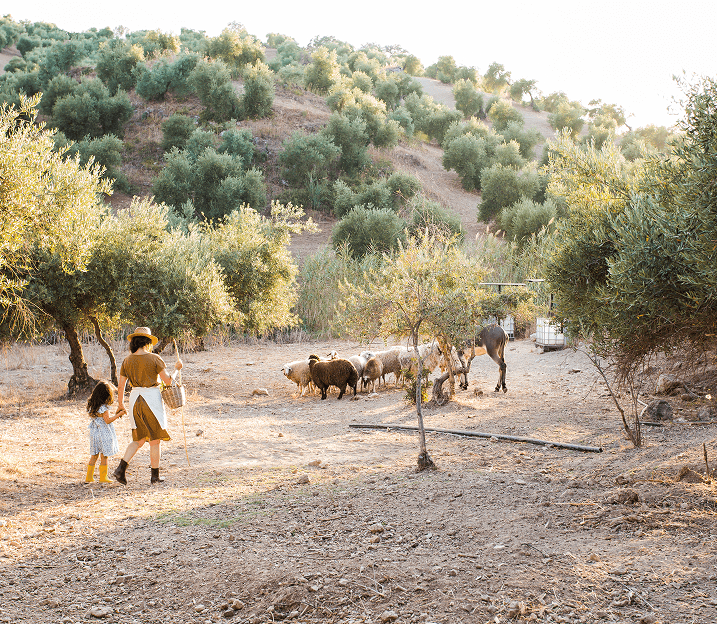
The story of organic olive oil begins long before the olives reach the mill.
It begins in the grove.
Olive trees grow within a living agricultural environment shaped by:
- soil,
- rainfall,
- sunshine,
- temperature,
- local biodiversity,
- the olive variety,
- farming practices,
- harvest timing.
Organic production places particular importance on the way farmers manage this environment.
The principles behind organic farming include maintaining soil fertility, encouraging biodiversity and limiting the use of certain external inputs.
For olive oil, this means that organic certification tells you something about the way the olives were produced before they ever entered the mill.
It does not tell you everything about the final olive oil, but it adds an important layer of information about its agricultural origin.
The environment in which olives grow can also influence the character of the finished oil. Read more about how growing region influences the taste and quality of olive oil.
Is Organic Olive Oil Healthier?
Organic certification alone does not prove that one olive oil is healthier than another.
This is an important distinction.
Organic certification primarily tells you about the production system. It does not guarantee a particular acidity level, polyphenol concentration, flavour profile or nutritional composition.
Two certified organic olive oils can differ greatly from one another.
Olive variety, harvest timing, fruit condition, climate, extraction, storage and age can all influence the characteristics of the finished oil.
The same applies when comparing organic and conventional extra virgin olive oils.
A carefully produced conventional extra virgin olive oil can have excellent chemical and sensory characteristics, while organic status alone does not guarantee exceptional quality.
For consumers interested in the composition of olive oil, factors such as fatty acid profile and naturally occurring phenolic compounds deserve separate consideration.
You can explore these topics in our guides to polyphenols in olive oil and the health benefits associated with extra virgin olive oil.
Organic vs Extra Virgin Olive Oil: What Is the Difference?
Organic and extra virgin describe two different things.
Extra Virgin Olive Oil
Extra virgin refers to the category of olive oil.
To qualify as extra virgin, olive oil must meet defined chemical and sensory requirements. It must also come directly from olives through mechanical or other physical methods without refining.
Free acidity is one of the laboratory parameters used in classification, although it is only one part of the quality assessment.
Our guide to olive oil acidity explains why this measurement matters and why low acidity alone does not define an exceptional olive oil.
Organic Olive Oil
Organic describes the certified production system used to grow, handle, process and market the product.
An olive oil can therefore be extra virgin without being organic.
It can also be both certified organic and extra virgin.
For consumers seeking both the extra virgin category and a certified organic production system, seeing the two together provides two separate pieces of information about the same oil.
Does Organic Certification Guarantee Better Olive Oil?
No certification can replace the complete assessment of olive oil quality.
Organic certification verifies the production system. It does not automatically tell you whether the oil has a beautifully balanced flavour, extremely low acidity, high polyphenol content or outstanding freshness.
These characteristics depend on additional factors.
For example, producers still need to harvest healthy olives carefully, take them to the mill quickly, manage extraction correctly and protect the finished oil from heat, oxygen and light.
This is why the strongest olive oil labels provide several pieces of useful information rather than relying on a single claim.
A product may be:
- extra virgin,
- certified organic,
- single varietal,
- single estate,
- from an identified region,
- from a recent harvest,
- supported by laboratory information.
Together, these details can provide a much clearer picture of what you are buying.
Our guide to how to choose a good extra virgin olive oil explains how to assess all these factors together.
Why Does Organic Certification Matter to Consumers?
Without certification, an organic claim would depend largely on trust between the consumer and the producer.
A producer could say that the olives were grown organically, but most consumers would have no practical way to check the farm records, approved inputs, storage procedures or traceability documentation themselves.
Certification changes that relationship.
It creates a structured system with defined rules, records, inspections and accountability.
This does not mean the system can answer every question about quality.
What it does provide is independent verification that the product operates within a recognised organic framework.
For the consumer, that creates greater transparency.
What Does Organic Certification Mean for the Producer?
From the outside, organic certification may look like little more than a small symbol on a bottle.
For the producer and other certified operators, it involves considerably more.
Businesses operating within an organic system must follow the relevant standards, maintain records and allow control bodies to verify their activities.
Organic status therefore creates additional responsibilities throughout the supply chain.
Records must support traceability, and certified operators need procedures that protect the organic integrity of the product during handling and storage.
For businesses importing organic products into Great Britain, certification requirements also apply to the importer.
This is why organic certification should not be viewed simply as a decorative marketing logo.
It represents participation in a controlled production and supply system.
What About Words Such as Natural, Traditional and Artisan?
Olive oil labels often use attractive words.
You may see descriptions such as:
- natural,
- traditional,
- artisan,
- family produced,
- farm grown,
- from the grove,
- small batch.
These descriptions may communicate genuine characteristics of a product.
However, they do not mean the same thing as certified organic.
If organic production matters to you, look for the information that supports the certification rather than relying only on descriptive language on the front of the bottle.
A useful distinction is simple.
Marketing language describes a product. Certification verifies compliance with a defined system.
How to Choose Certified Organic Olive Oil
When buying organic olive oil, you do not need to study every detail on the label for several minutes.
A short checklist can tell you a great deal.
1. Is It Extra Virgin Olive Oil?
If you want the highest recognised category of virgin olive oil, look for the words extra virgin.
2. Is the Organic Certification Clear?
Do not rely only on the word organic printed prominently on the front.
Look for the certification and control information required for the market in which the product is sold.
3. Can You Identify the Control Body?
A recognised control body code helps connect the organic claim with the certification system behind it.
4. Where Were the Olives Grown?
Look for clear information about agricultural origin and, where available, the region or estate.
5. Does the Producer Identify the Olive Variety?
Knowing the variety can tell you more about the expected style and character of the olive oil.
6. Is There a Harvest Date or Harvest Year?
Recent harvest information can help you assess the freshness of the oil more effectively than a best before date alone.
7. Does the Packaging Protect the Oil?
Dark glass bottles and metal tins help reduce exposure to light, one of the factors that can accelerate olive oil deterioration.
8. Does the Producer Provide Useful Quality Information?
Details about acidity, polyphenols, harvest, extraction, estate or storage can help you understand the product beyond the organic logo itself.
Organic Olive Oil Is About More Than a Green Leaf
The next time you see the word organic on a bottle of olive oil, it is worth looking beyond the front label.
Organic certification does not promise that an olive oil will automatically taste better, contain more polyphenols or offer superior nutritional characteristics.
What it does tell you is that the product belongs to a defined system of organic production, control and traceability.
That distinction matters.
Consumers cannot personally inspect every olive grove, check every farm record or follow every container through storage and distribution.
Certification provides an independent framework designed to verify those processes.
For anyone who wants to make a more informed choice, the organic logo, control body information, origin, harvest details and olive oil category should therefore be considered together.
A good olive oil begins long before the bottle reaches your kitchen.
It begins in the soil, on the tree and in the decisions made throughout the olive grove.
Organic certification helps make that part of the story more transparent.
See similar articles
Extra Virgin Olive Oil Guide 26 APRIL 2026
Why Is Crete Famous for Olive Oil? The Story of Cretan Olive Oil
Some landscapes are so distinctive that you can recognise them without looking at a map. Across…
Read more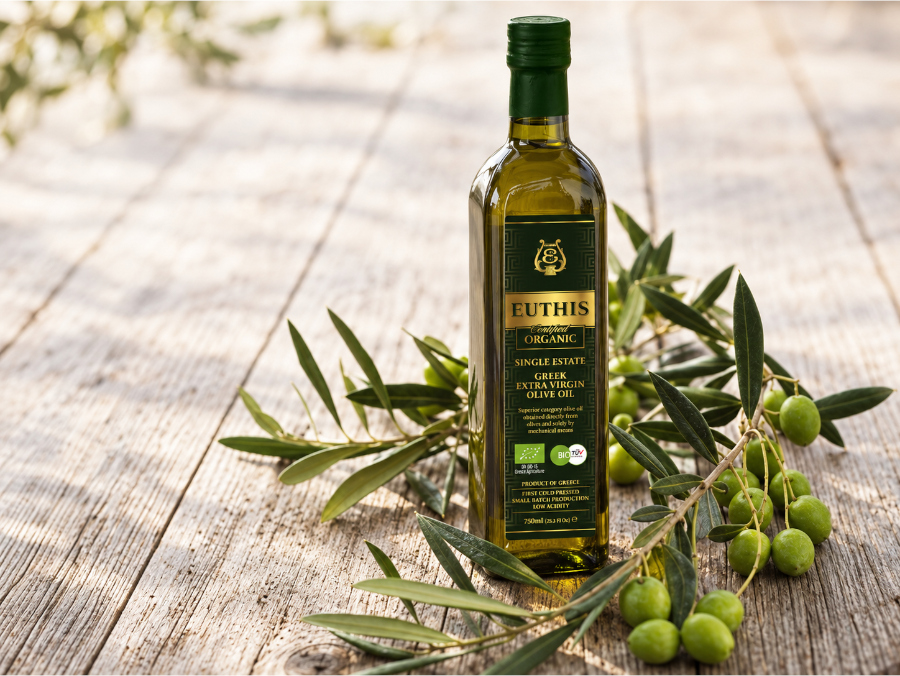
Extra Virgin Olive Oil Guide 07 FEBRUARY 2026
How to Choose a Good Extra Virgin Olive Oil: 10 Things to Look For
You are standing in front of a supermarket shelf filled with olive oil. There may be…
Read more
Extra Virgin Olive Oil Guide 18 JANUARY 2026
Cooking with Extra Virgin Olive Oil: How to Use It Every Day
Imagine a simple Mediterranean dinner. Ripe tomatoes, fresh herbs, a piece of good bread and a…
Read more

EUTHIS combines organic cultivation, Koroneiki single varietal character, cold extraction, and single estate traceability. It is produced with clear standards and handled to protect freshness through to final packaging.